Zwicky and Rubin
A fringe idea, then the outer stars
“It might seem impossible to discover something that can’t be seen, but scientists have been trying to untangle the mystery of dark matter since at least the 1930s.”[source]
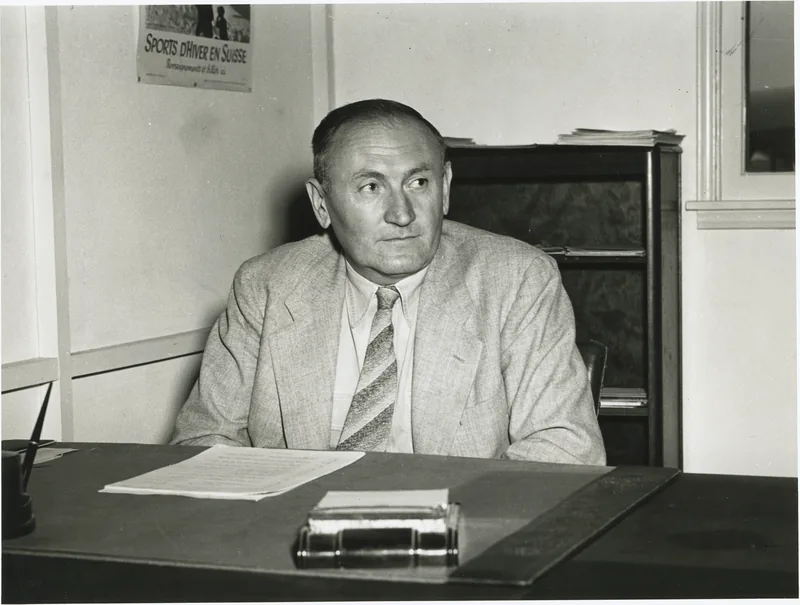
NASA’s Dark Matter page is careful about the name itself. “While the term dark matter was mentioned in earlier publications, the current concept of dark matter materialized in the early 1930s.” In 1933, “Swiss-born astronomer Fritz Zwicky published a paper in which he described an anomaly he observed studying a cluster of galaxies known as the Coma Cluster.”[source]
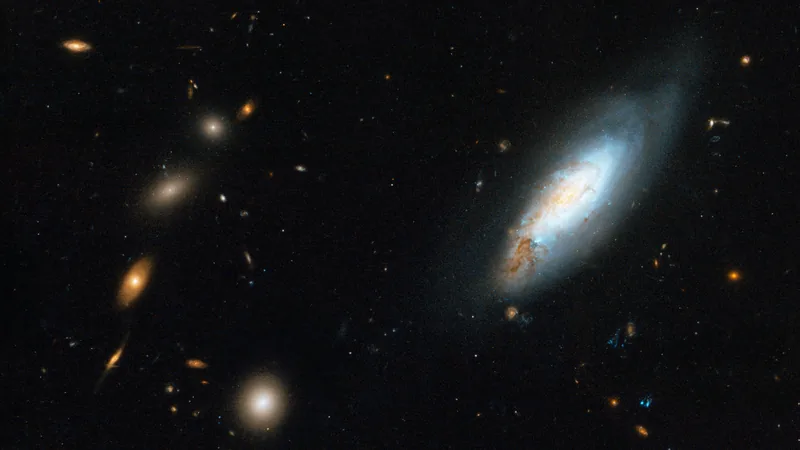
“He noticed that the galaxies in the cluster moved too quickly for the gravity created by its observed ordinary matter. The galaxies should have been escaping the cluster, but instead, they were staying together.” After noting the discrepancy, “Zwicky suggested that there might be an invisible form of matter that created the gravity holding these galaxies together. He dubbed this mysterious material ‘dunkle Materie,’ which is German for dark matter.”[source]
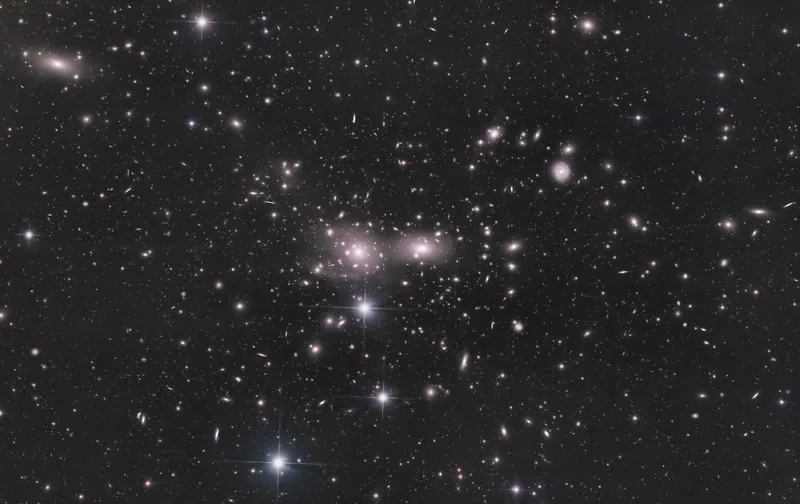
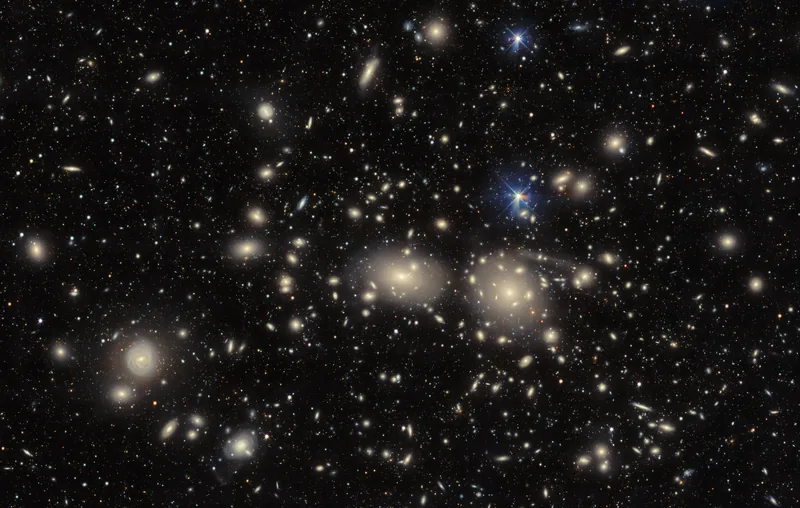
The photographs of Coma on this site are modern views of that cluster — a Hubble close-up, a wide NOIRLab landscape, and an amateur still from Estonia. They are not Zwicky’s original plates. The story those later pictures illustrate is the official 1933 one.[source]
The idea did not win at once. “While these early investigations sparked ideas and curiosity around dark matter, it was still seen as a fringe concept without sufficient evidence to support it.”[source]
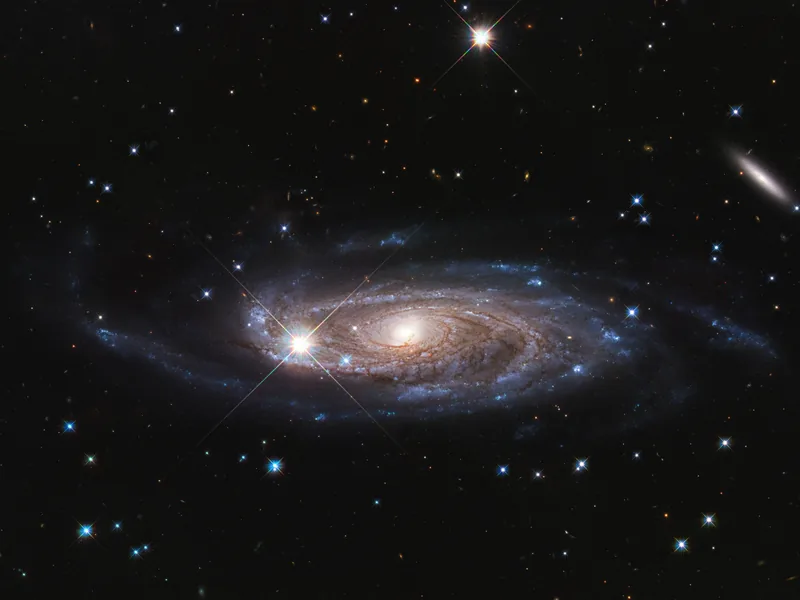
“That changed in the 1970s when American astronomer Vera Rubin observed this ‘missing matter’ problem in spiral galaxies. Rubin looked at the stars on the outer edges of the spirals. To explain why these stars moved as fast as they did without flying into intergalactic space, there had to be a large amount of matter holding them in place. But, not seeing any of this matter, Rubin concluded that these galaxies must be held together by dark matter.”[source]
“Rubin’s discovery provided such strong evidence for dark matter that the concept was embraced by the scientific community. Today, while not all astronomers agree on what dark matter might be, its existence is widely accepted.”[source]
Hubble’s dark-matter page tells the same turn in a shorter official line. “Astronomer Vera Rubin, known as the ‘mother of dark matter,’ found that stars in the outer reaches of galaxies were moving at speeds similar to stars closer to the center, a result only possible if a huge amount of invisible matter was present in those outer regions.”[source]
A later official comparison makes the surprise easy to picture. A Hubble simulation shows two spirals. One rotates “like an old-fashioned vinyl record on a turntable,” with “all of the visible stars rotate at the same angular rate.” The other spins fastest toward the centre. “We expected galaxies to exhibit rotation like one on the right, given mass estimates based on the luminous matter alone. However, observations have shown that galaxies rotate more like the galaxy on the left, pointing to a huge amount of matter that is unseen at any wavelength of light that we can detect.”[source]
UGC 2885, the spiral on this page, has been nicknamed Rubin’s galaxy. It is a modern Hubble still, credited to NASA, ESA and B. Holwerda — not one of Rubin’s original observation plates. The nickname is a later honour, not a claim about the photograph’s date.[source]
Enjoyed this dark-matter desk?
No pop-ups. No intrusive advertising. Just interesting stuff. A little support helps the next galaxies.im site get built.