Gravitational lensing
A collision, and a map of the missing mass
“Today, scientists have even more direct evidence of dark matter. While dark matter doesn’t interact with light, its gravity can bend light from distant galaxies, creating an effect called gravitational lensing.”[source]
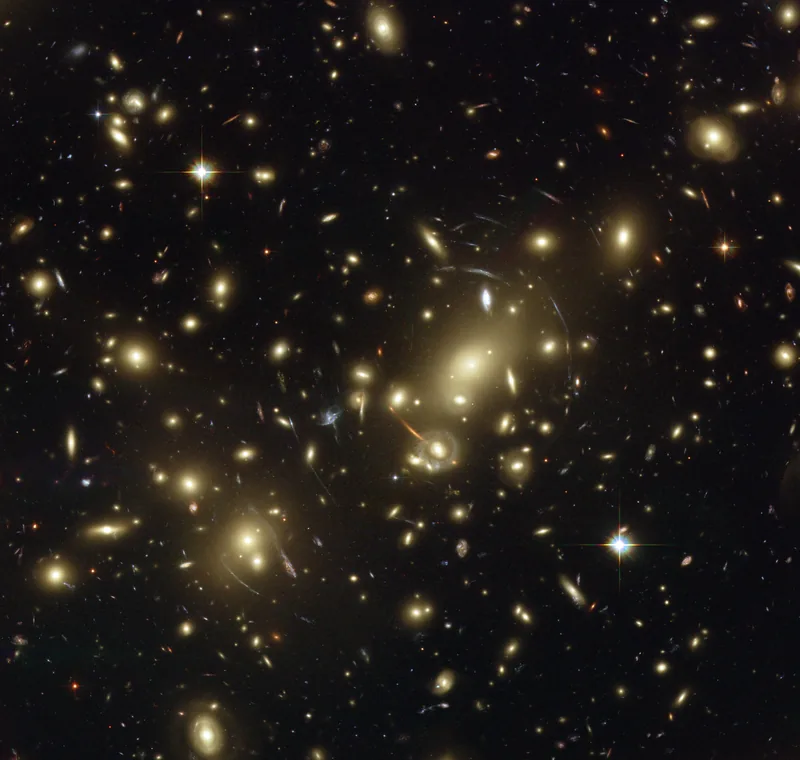
“Studying galaxies distorted by gravitational lensing can help scientists better understand dark matter and its place in the universe.” Hubble’s page says the telescope “studies dark matter by observing the distorting and magnifying effects its gravity has on the light emanated by visible objects.”[source][source]
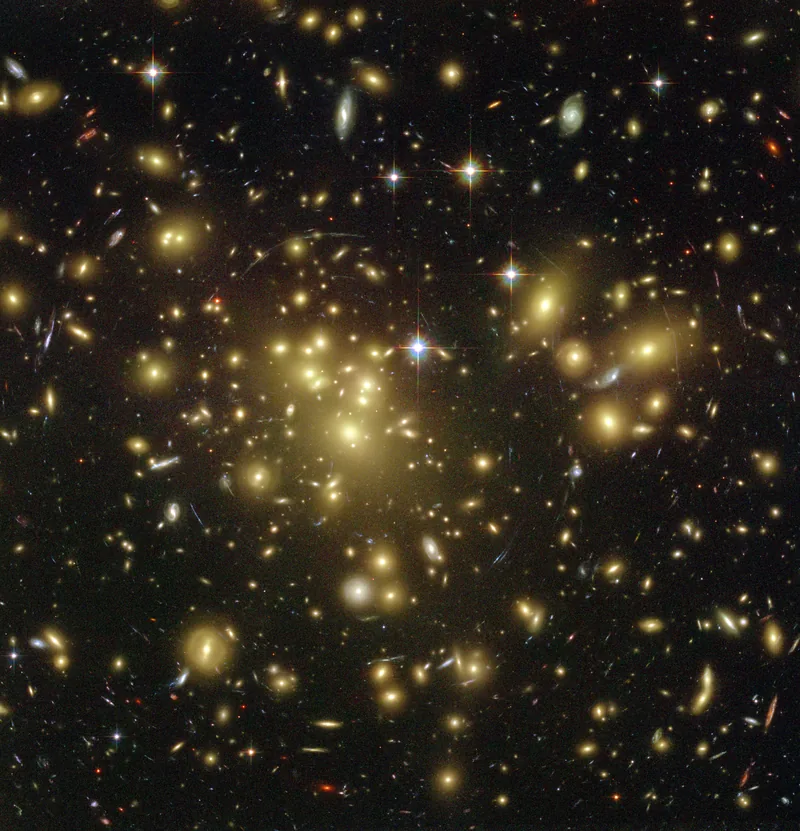
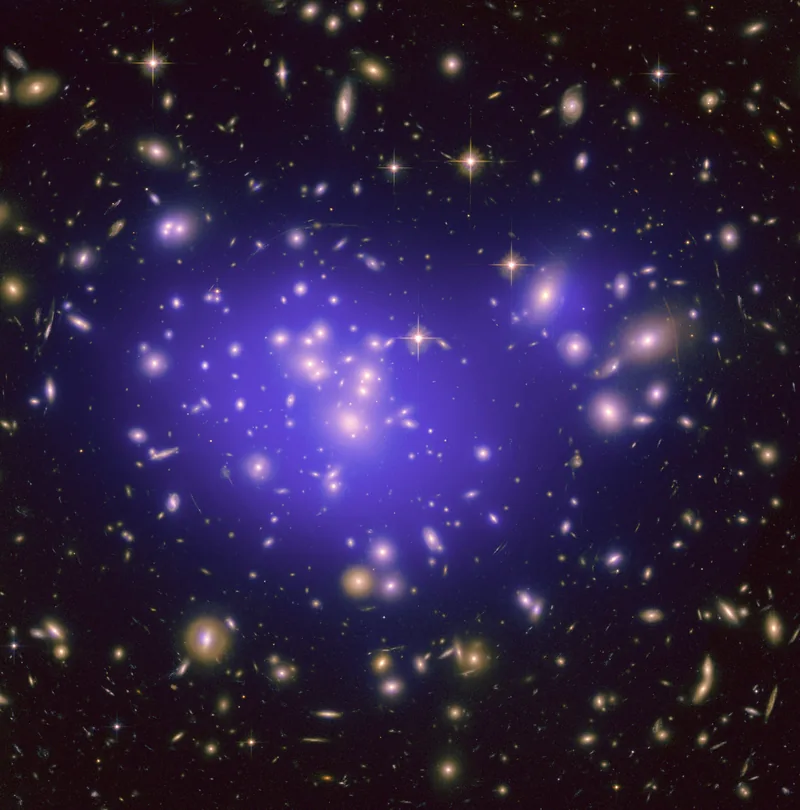
In 2006, NASA’s Dark Matter page says, “scientists observed the Bullet Cluster and discovered some of the best direct evidence for dark matter. This galaxy cluster, formally known as 1E 0657-56, was created when two large galaxy clusters collided in an extremely energetic event about 3.8 billion light-years from Earth.”[source]
Hubble’s dark-matter page describes the same collision under a slightly different official catalogue spelling, 1E 0657-556. This site keeps both forms, with the pages that wrote them, and does not treat one as a correction of the other.[source][source]
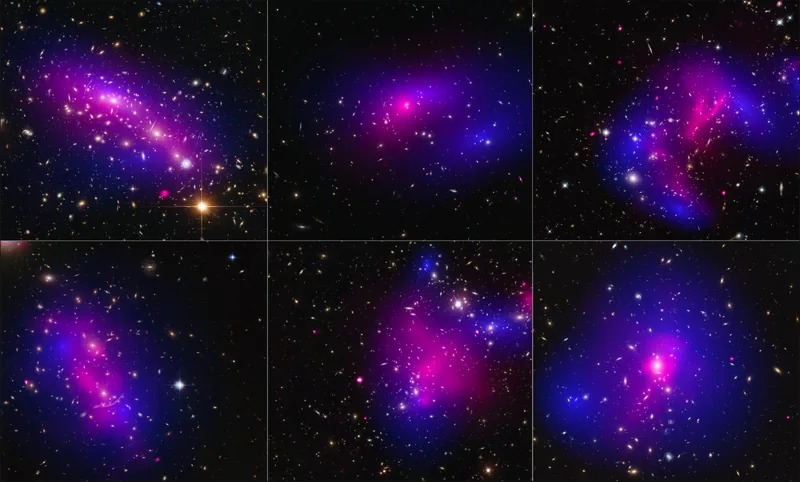
During the collision, “hot gas from one cluster interacted with hot gas from the other.” In the official composite described on the Dark Matter page, “hot X-ray emitting gas made of normal matter and detected by NASA’s Chandra X-ray Observatory is shown in pink. The blue portions show the distribution of dark matter and were revealed using gravitational lensing observations taken by NASA’s Hubble Space Telescope and the Giant Magellan Telescope.” The blue areas “represent most of the mass in these clusters and are distributed differently than the hot gas.”[source]
Hubble’s page is just as plain. Most of the “normal,” or baryonic, matter is in the pink X-ray gas. The galaxies appear in orange and white. The blue areas “depict where astronomers calculated that most of the mass in the clusters must be.” “Most of the matter in the clusters (blue) is clearly separate from the normal matter (pink), giving direct evidence that nearly all of the matter in the clusters is dark.” NASA’s Dark Matter page calls the observation “one of the clearest direct examples of dark matter.”[source][source]
This site tells that official story, and shows colliding clusters and mass maps whose credits are clean public-domain or clearly licensed stills. It does not use a Bullet Cluster composite whose published credit includes ESO’s WFI camera, and it does not treat a purple or blue overlay as a photograph of dark matter itself.[source]
Hubble’s page adds other official results from the same kind of work. Hubble “helped ‘weigh’ our Milky Way galaxy to estimate its mass, most of which is locked up in dark matter.” It “found that galaxies can be embedded in haloes of dark matter, and that dark matter can be forced away from galaxy clusters and separated from normal matter by galaxy collisions.” It “found the smallest clumps of dark matter known and strikingly concentrated clumps of dark matter.”[source]
Dark matter, that page says, “is thought to be the scaffolding that normal matter arranges itself around and upon, a web woven through the universe whose gravity attracts normal matter.” Hubble has “played a major role in helping map the presence of dark matter throughout the cosmos, including the creation of a three-dimensional map that offered the first look at the web-like large-scale distribution of dark matter in the universe.”[source]
The same official page uses Abell 370 as an example of lensing so strong that “a distant supernova that appeared multiple times in this Hubble image due to its light being distorted and split by the cluster’s gravity.” The warped light, the caption says, “produced three images of the explosion.” This site tells that official story. It does not include a still of Abell 370 in this photograph set.[source]
Enjoyed this dark-matter desk?
No pop-ups. No intrusive advertising. Just interesting stuff. A little support helps the next galaxies.im site get built.