How much is there?
Two official budgets, side by side
Official pages agree that most of what holds the universe together is not the matter we can see. They do not all say so in the same figures. This page keeps the wordings apart.[source][source]
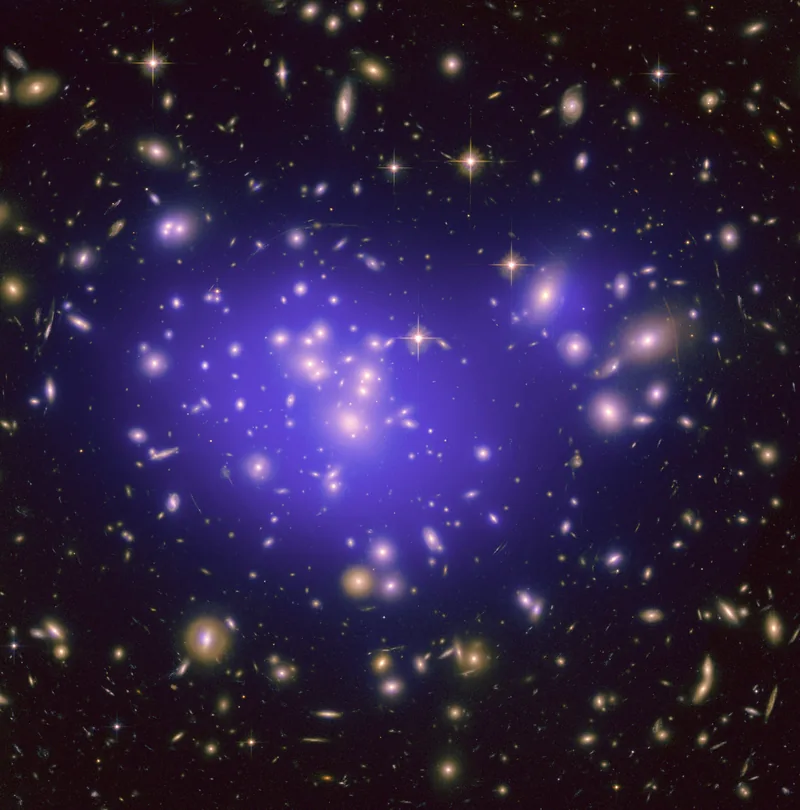
NASA’s Dark Matter page, by Chelsea Gohd of the Jet Propulsion Laboratory, gives this estimate: “ordinary matter makes up only about 5% of the universe, while dark matter makes up about 27%. (The rest is thought to be dark energy, which is its own mystery).” A later sentence on the same page is the same budget in three parts: “The universe is made up of three components: normal or visible matter (5%), dark matter (27%), and dark energy (68%).”[source]
NASA Space Place, a page written for families, stays in that same family of figures: “about 27%,” “roughly 68%,” and “less than 5%.” This site keeps the children’s wording with the main Dark Matter page, and does not treat it as a third, independent census.[source][source]
Hubble’s dark-matter page uses different official wording, kept here as written: “It’s theorized to make up 85 percent of the universe’s total mass, or almost 30 percent of the universe’s combined mass-energy.”[source]
Those two official accounts are not averaged on this site, and one is not treated as a rounding of the other. “Total mass” and “combined mass-energy” are not the same kind of whole, and “about 27%” is not rewritten as “almost 30 percent.” Each figure stays with the page that wrote it.[source][source]
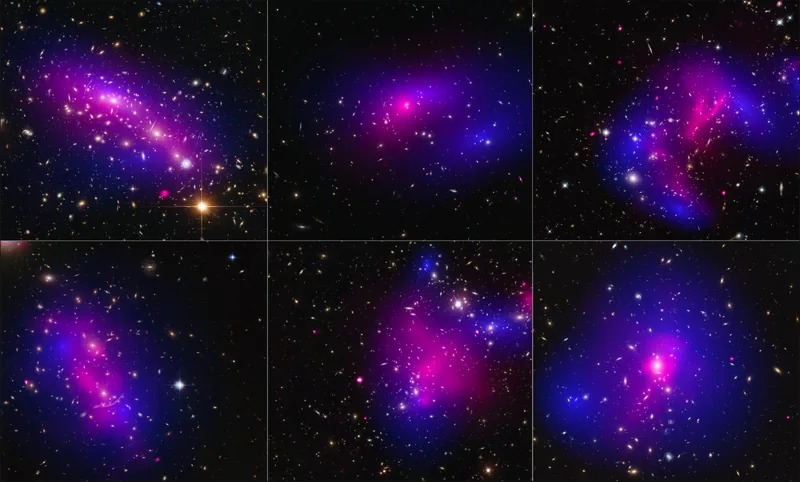
What both official stories share is the shape of the problem. Hubble’s page says “none of it is enough” — meaning all the stars, gas, dust, continents and living things we can see. “The more mass something has, the greater its gravity. But scientists have calculated that all the matter we can see in the universe doesn’t add up to enough gravity to keep galaxies from flying apart, or to allow them to form in the first place.”[source]
Among other investigations, “Hubble helped ‘weigh’ our Milky Way galaxy to estimate its mass, most of which is locked up in dark matter.”[source] The question on this page is not whether official pages think the missing mass is real. It is how they describe its share, in their own words.
NASA’s Dark Matter page looks forward as well as back. “Since dark matter is essentially the glue holding the universe together, a better understanding of the distribution of dark matter will help answer big cosmic questions about how the universe is organized and how it has changed over the course of cosmic history.” Maps of that distribution, the page says, will be “created with the help of missions like NASA’s upcoming Nancy Grace Roman Space Telescope.”[source]
Enjoyed this dark-matter desk?
No pop-ups. No intrusive advertising. Just interesting stuff. A little support helps the next galaxies.im site get built.