Leading candidates
What it might be — and what has not been found
“There are currently many proposed explanations for what makes up dark matter.” Official pages even allow that “it’s possible that dark matter is made up of more than one kind of matter or particle.” None of the leading candidates has been confirmed.[source]
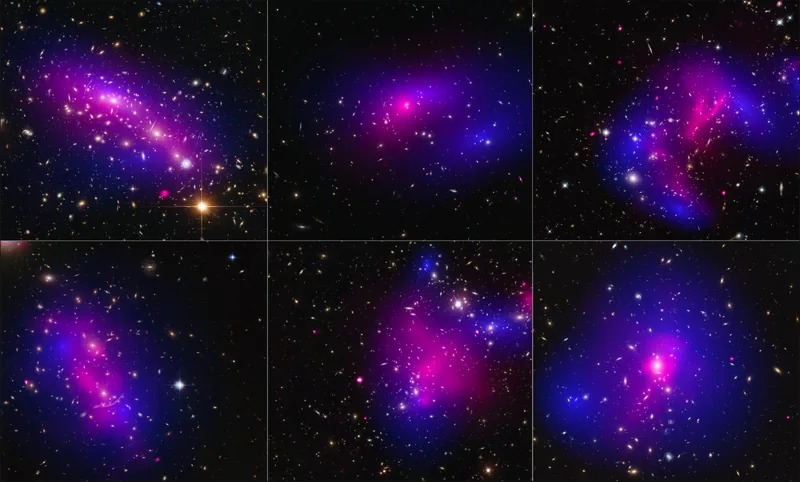
NASA lists “a few of the current candidates with the most support from the scientific community,” then adds the caution this page keeps in view: scientists “have been searching for these candidates but have not yet found evidence which would confirm any candidate. New candidates may also continue to emerge.”[source]
WIMPs — Weakly Interacting Massive Particles — “are hypothetical particles that are big, heavy, and slow-moving. They don’t absorb or emit light or strongly interact with any other particles that we’ve seen so far.” Official wording says they may interact with gravity “and possibly other forces, but in a way that allows these particles to pass through normal matter almost seamlessly.” If WIMPs “interact with each other, however, they may cancel each other out. That destruction could produce gamma rays.” Scientists “have even searched through data from NASA’s Fermi Gamma-ray Space Telescope to look for signatures of WIMPs interacting and annihilating one another.”[source]
Axions “are hypothetical subatomic particles scientists think are both low-mass and low-energy.” The particle “was first theorized in 1977 as a solution to a fundamental problem within particle physics called the strong CP problem.” Official pages describe that problem, then add that scientists “think that these hypothetical particles could be dark matter.” Data from Fermi, Chandra and NuSTAR have been used “to search for evidence of axion oscillations in X-ray and gamma-ray observations.”[source]
Primordial black holes are “hypothetical black holes scientists think formed right after the birth of the universe.” Official wording says they “could be as small as an atom or as large as a supermassive black hole, with possible masses ranging from 100,000 times less massive than a paperclip to 100,000 times more massive than the Sun.” “Recent studies suggest a primordial black hole could travel through our solar system once every 10 years, which may allow scientists to eventually study them directly.” One theory, “proposed by physicist Stephen Hawking, suggests that after primordial black holes formed from regular matter at the start of the universe, they collapsed, becoming dark matter that spread out across the universe.” Scientists use Fermi data “to search for primordial black hole evaporation.”[source]
A related official conclusion is about temperature, not about a named particle. “Because dark matter has mass, it also must have a temperature.” Simulations of a cold, slow-moving kind “appear to exist and move as they are observed in reality.” Simulations of warm or hot, faster-moving dark matter do not let “cosmic structures” “stick together” as we see them. “Based on such simulations, scientists currently agree that it is most likely that whatever dark matter is, it is cold or slow-moving.”[source]
Hubble’s page is shorter, and just as open: “No one knows exactly what dark matter is, but theories posit that it consists of currently unknown particles that rarely interact with normal matter.”[source] This site lists the official candidates. It does not promote one of them as a discovery.
Enjoyed this dark-matter desk?
No pop-ups. No intrusive advertising. Just interesting stuff. A little support helps the next galaxies.im site get built.