Can we see it?
Invisible, but not imaginary
“So, what can we see? And what have we seen that makes us so sure that dark matter exists?” NASA’s Dark Matter page asks the question this desk is built around.[source]
From stars and galaxies “to the shoes on your feet,” ordinary matter is “everything we can see in the universe — in wavelengths spanning from the infrared to visible light and gamma rays.” Dark matter is different. “While dark matter interacts with ordinary matter through gravity, it does not seem to interact at all with the electromagnetic spectrum, including visible light. So dark matter doesn’t absorb, reflect, or emit any light.”[source]
That is why the name causes trouble. “Dark matter is not a dark color. Rather, it’s called ‘dark’ because it’s invisible to us.” Hubble’s page says the same in other words: “an invisible form of matter that doesn’t emit, absorb or reflect light, or interact with normal matter.”[source][source]
And it is not the other official mystery with “dark” in the name. “While the two are both cosmic mysteries with ‘dark’ in their name, they are not the same thing. Dark matter is a mysterious type of matter that holds galaxies together. Dark energy is the name scientists have given to whatever is causing our universe to expand at an accelerating rate over time.” Dark energy “isn’t concentrated in galaxies or galaxy clusters,” but is thought to be “spread throughout the universe.”[source]
What dark matter does share with ordinary matter, official pages say, is simpler: “It takes up space and it holds mass. Because of this, we can see how it interacts with and influences ordinary matter throughout the universe, which is how we’re able to ‘see’ and study dark matter.”[source]
Hubble’s page puts the same problem in one hard sentence. “Scientists have calculated that all the matter we can see in the universe doesn’t add up to enough gravity to keep galaxies from flying apart, or to allow them to form in the first place. Something else must be out there.”[source]
The same page opens even more simply: “There’s enough matter in the universe to keep everything from flying apart ― but we can’t see it, and we don’t know exactly what it is.” Gravity, it says, “is the glue that holds the universe together, collecting stars into galaxies, keeping planets on track around their stars, and drawing galaxies together into mergers across space. The more mass something has, the greater its gravity.” All the visible matter is still “not enough.”[source]
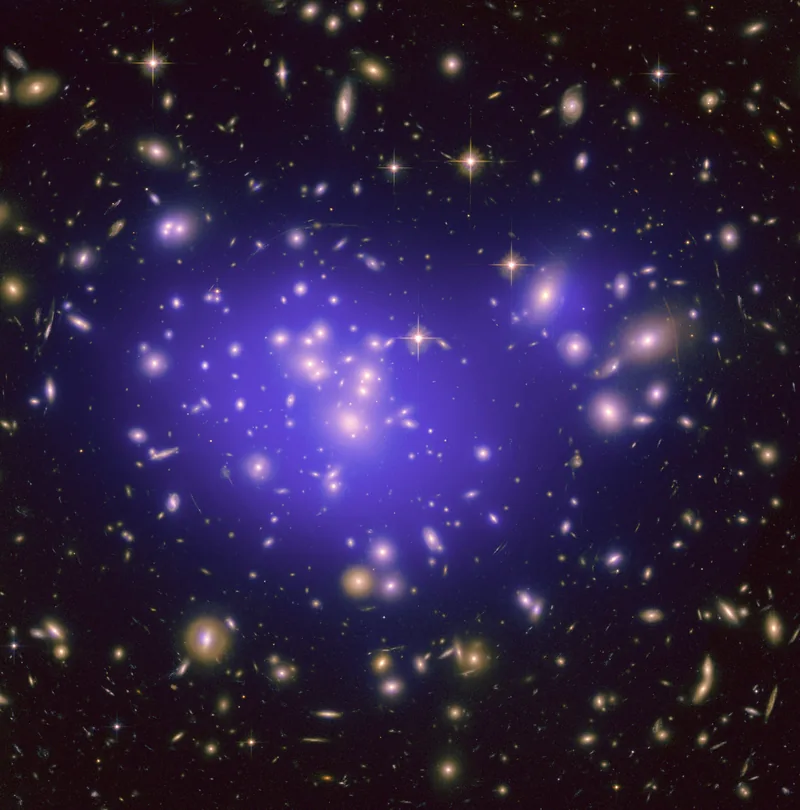
The purple overlay on the Abell 1689 still on this page is a map of where most of the mass must be, not a colour photograph of the dark matter itself. Official pages are careful about that distinction, and so is this desk.[source][source]
Enjoyed this dark-matter desk?
No pop-ups. No intrusive advertising. Just interesting stuff. A little support helps the next galaxies.im site get built.